
Cost-plus contract payments
Managing payments on a cost-plus building contract
A cost-plus contract is only as transparent as its records. The owner pays actual costs plus a margin, so every invoice, every approval and every payment has to be recorded and provable, or the final number is whatever the paperwork says.
Under a cost-plus contract there is no single locked price. The owner pays the real cost of labour and materials as the job proceeds, plus an agreed margin. That makes cost-plus the most open structure on paper and, without disciplined records, one of the hardest to trust in practice.
This page covers what payment management has to do on a cost-plus residential build, where it usually breaks down, and what BuildFair does and does not handle today.
What cost-plus payment management needs
Cost-plus moves cost risk to the owner. In return, the owner needs costs that are properly backed. Four things make that work.
Evidence for every cost
Each subcontractor and supplier invoice needs proof the work was done or the materials arrived, not just a line on a summary.
Approval before scope changes
The line between a variation and ordinary cost blurs under cost-plus. Changes in scope still need to be agreed in writing so the running total stays honest.
Project money kept separate
If owner payments land in the builder's operating account, nobody can show which costs they paid for. Keeping project funds separate is what lets each cost be matched to a payment.
A record nobody can quietly edit
Disputes on cost-plus jobs are about what was spent. A tamper-evident record of what was claimed, approved and paid settles them faster than anyone's memory.
Where cost-plus payments break down
The common failure is a summary claim that bundles a month of costs with thin backing, an owner who cannot tell which invoices it covers, and a margin applied to a figure neither side has checked line by line. Questions follow, payment slows, and the builder carries the costs in the meantime.
The other is cash flow. On cost-plus the builder still pays trades and suppliers before the owner reimburses them, so the timing gap that hurts builders on fixed-price jobs is still there, often with more paperwork attached.
How BuildFair supports a cost-plus build
BuildFair handles the payment mechanics that sit underneath any contract structure.
Every invoice carries its evidence
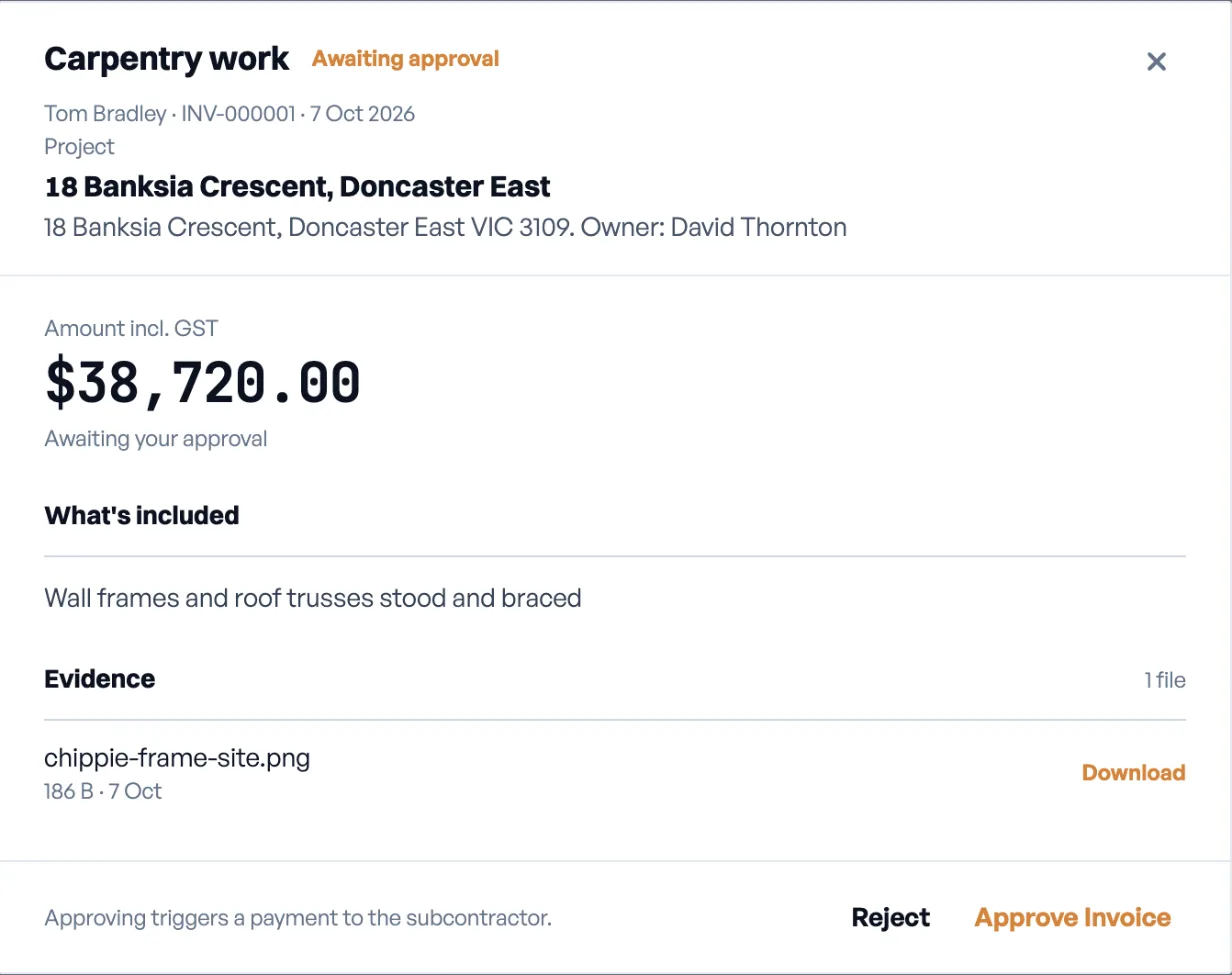
Subcontractor and supplier invoices run through the project with photo evidence attached, so each cost is backed by evidence of the work or materials.
Owner funds sit in a project account
Deposits and payments are held in a project account in the owner's name at Cuscal, through our banking partner Kobble (Kobble operates under AFSL 545391, Yondr Money Pty Ltd), separate from the builder's operating account, and trades are paid from that account one day from invoice approval. BuildFair is free for owners, who follow the build through photos, progress updates and stage status and can appoint an architect to run the project for them.
Variations are priced before they count
The builder sets the final price of a change. The owner then pays the variation deposit, or the owner side approves each claim against it.
A double-entry, hash-chained ledger
Every claim, approval and payment is recorded permanently and is tamper-evident, so the record cannot be quietly rewritten.
What BuildFair does not do on cost-plus yet
Builders can record a project as Cost Plus, but BuildFair does not yet calculate the builder's margin or produce an open-book cost claim automatically. Today the head contract runs on an agreed claim schedule, with each trade capped at its quote plus approved variations. If your cost-plus contract depends on margin calculations, keep doing those in your accounting system and talk to us about how the claim schedule is set up.
Cost-plus payments, two ways
| The current system | On BuildFair | |
|---|---|---|
| Backing for each cost | A monthly summary with invoices attached on request. | Photo evidence attached to every trade and supplier invoice. |
| Where owner money sits | The builder's operating account. | A project account held at Cuscal, through Kobble, for that job. |
| Scope changes | Agreed verbally, reconstructed later. | Priced by the builder, then funded by the owner's deposit or approved claim by claim. |
| The record | Spreadsheets and email threads. | A double-entry, hash-chained ledger of every movement. |
How BuildFair changes this
Managing a residential build? See how BuildFair manages construction payments, so builders and trades work from the same record of their claims and payments, and owners follow the build through photos and progress updates.
For builders
Run jobs without bankrolling them out of your own account
For owners
Your money sits in your name and only moves against claims on your job
How funds are held
How the project account works, the ledger, and the controls behind it
Pricing
Role-based plans with builder pricing tied to annual project count
Payments Accounts are issued by Yondr Money Pty Ltd (AFSL 545391), trading as Kobble. BuildFair is Yondr's corporate authorised representative (No. 001322934). Read the Product Disclosure Statement and Target Market Determination.
FAQ
Frequently asked questions
Can I use BuildFair on a cost-plus contract?
Yes. You can record the project as Cost Plus. The payment mechanics, evidence and ledger work the same way on every project. Margin calculation and open-book cost claims are not automated yet.
Is cost-plus or fixed-price better for owners?
Neither is universally safer. Fixed-price puts cost risk on the builder, cost-plus puts it on the owner. See fixed price vs cost plus contracts for the full comparison, and speak to a lawyer about the contract itself.
Does BuildFair hold the owner's money?
No. Funds are held at Cuscal, through our banking partner Kobble, which operates under AFSL 545391 (Yondr Money Pty Ltd). See how project funds are held.
Talk through a cost-plus job
Bring the contract structure and we will show you how the claims, evidence and payments would run. Book a BuildFair demo, or see BuildFair pricing plans first.
Last reviewed