
Subcontractor payment software
Subcontractor payment software for residential builders
Every subcontractor on a job has a quote, a running invoice total, possibly a variation or two, and a date they expect to be paid. Keeping all of that straight across several jobs is where most builders lose hours, and where most subcontractors lose patience.
Paying subcontractors looks like accounts payable. In practice it is a set of questions that have to be answered for every invoice: is the work done, is the amount inside the quote, was the extra work approved, and is there money to pay it. When those answers live in different places, invoices sit, and the subcontractor at the end of the payment chain waits.
This page covers what subcontractor payment software has to do on a residential build, where the usual process stalls, and how BuildFair runs it from project funds.
What subcontractor payment management involves
Four checks sit between a subcontractor's invoice and their bank account. Each is a place the payment can stall.
Is the work done?
Photos or a site check, usually gathered after the invoice arrives rather than with it.
Is the amount inside the quote?
Running totals against each subcontractor's quote are often tracked in a spreadsheet, if they are tracked at all.
Was the extra work approved?
A variation agreed on site and never written up is the most common reason an invoice does not reconcile.
Is there money to pay it?
In the current system the answer depends on the builder's operating account that week, not on whether the work is done.
Why subcontractor payments run late
Late subcontractor payments are usually a timing problem rather than a decision. The stage payment that covers the work has not cleared, and the operating account is covering several jobs at once. The subcontractor's invoice is correct and approved, and still waits its turn.
The rest is reconciliation. An invoice that does not match the quote, or includes work nobody wrote down, gets parked while two people try to remember a conversation. That is how a 30-day term turns into 60, and why subcontractors don't get paid on time even on profitable jobs.
How BuildFair runs subcontractor payments
The same four checks, answered before the invoice is paid.
Evidence comes with the invoice
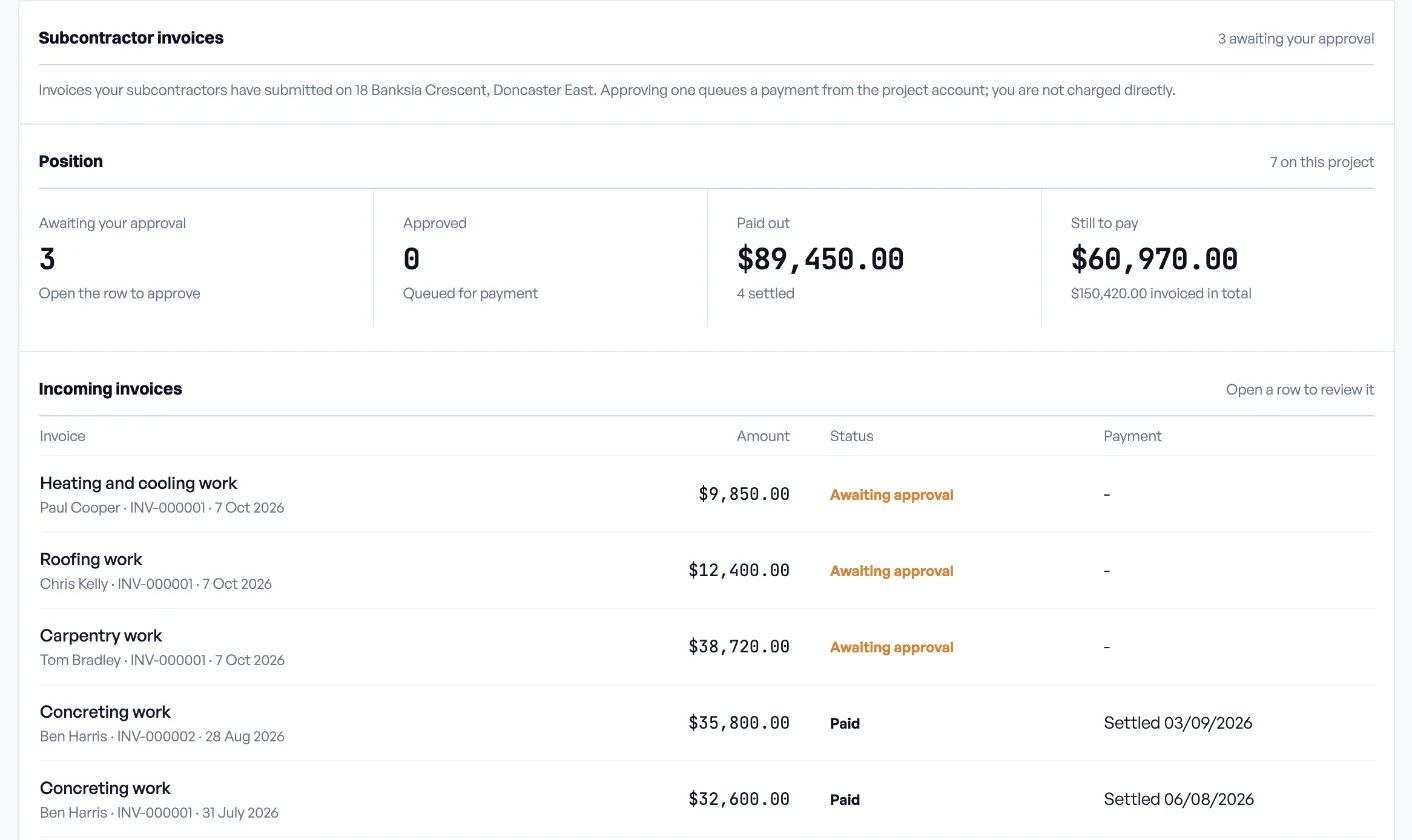
Subcontractor invoices carry photo evidence of the completed work, so approval is about the work in front of you rather than a request for proof.
Quotes are hard caps
No subcontractor can invoice more than their quoted value plus approved variations. The platform enforces the cap, so totals reconcile at every claim.
Variations are approved in writing
The builder sets the final price of a change before it counts, then the owner pays the variation deposit or the owner side approves each claim against it, so the extra work is on record before it is invoiced.
Paid from project funds on a fixed clock
Approved invoices are paid from the project account held in the owner's name at Cuscal, through our banking partner Kobble, one day from approval. The payment is recorded the moment the invoice is approved, so the subcontractor knows the date instead of guessing it.
Quotes, claims and invoices in one place
Subcontractors keep their quotes, claims and invoices together, and can quote from their own private takeoff. Your takeoff is your own: the builder does not see it.
Only verified people can be paid
Every subcontractor is identity-verified before they can receive funds, so payments only go to people working on the project.
One subcontractor invoice, two ways
| The current system | On BuildFair | |
|---|---|---|
| Proof the work is done | Requested after the invoice arrives. | Photo evidence attached to the invoice. |
| Checking against the quote | Manual, if done at all. | Enforced. Quote plus approved variations is a hard ceiling. |
| Extra work | Agreed on site, argued about at invoice time. | Priced by the builder, then funded or approved by the owner side. |
| When the subcontractor is paid | When the operating account allows. | One day from approval, from project funds. |
| Where the money comes from | The builder's pooled operating account. | The project account held at Cuscal, through Kobble, for that job. |
How BuildFair changes this
Managing a residential build? See how BuildFair manages construction payments, so builders and trades work from the same record of their claims and payments, and owners follow the build through photos and progress updates.
For builders
Run jobs without bankrolling them out of your own account
For subcontractors
Get paid on a fixed clock from funds already set aside
Builder cash flow management
Pay trades and overheads from project funds, not your own account
Pricing
Role-based plans with builder pricing tied to annual project count
Payments Accounts are issued by Yondr Money Pty Ltd (AFSL 545391), trading as Kobble. BuildFair is Yondr's corporate authorised representative (No. 001322934). Read the Product Disclosure Statement and Target Market Determination.
FAQ
Frequently asked questions
Do subcontractors pay to use BuildFair?
Subcontractors have their own plans: $250/month (12-month minimum), $2,500/year or $500 per project, plus GST. See BuildFair pricing plans for the current options, and how subcontractors get paid on BuildFair for the subcontractor's view.
What happens to retention?
A retention amount can be held back and released after completion once open defects are resolved. See how much retention to hold.
Does this replace Security of Payment rights?
No. Subcontractors keep their statutory rights under state Security of Payment legislation. BuildFair works upstream of them, so fewer payments reach the point of a claim.
What if a subcontractor's materials are bought by the builder?
Materials the builder pays for on a subcontractor's behalf are set off against what that subcontractor is owed, so the totals stay accurate.
Run your next subcontractor invoice through it
Bring a live job and a few open subcontractor invoices and we will walk through approval, caps and the payment date. Book a BuildFair demo, or read about builder cash flow management.
Last reviewed